From the Sidelines · Ask Dr. G
When In Doubt, Sit It Out
Hit your head on the slopes and feel a little off? Your day is over. Why one more run is the riskiest choice you can make, and what to do instead.
Ask Dr. G
Q: "I crashed skiing last weekend and hit my head on a groomer. I got up a little dizzy and my head was pounding, but my helmet looked fine and the lifts were about to close. I really wanted one more run. How do I know if a head hit is serious enough to stop for the day?" - Mark T., Burlington, Vt.
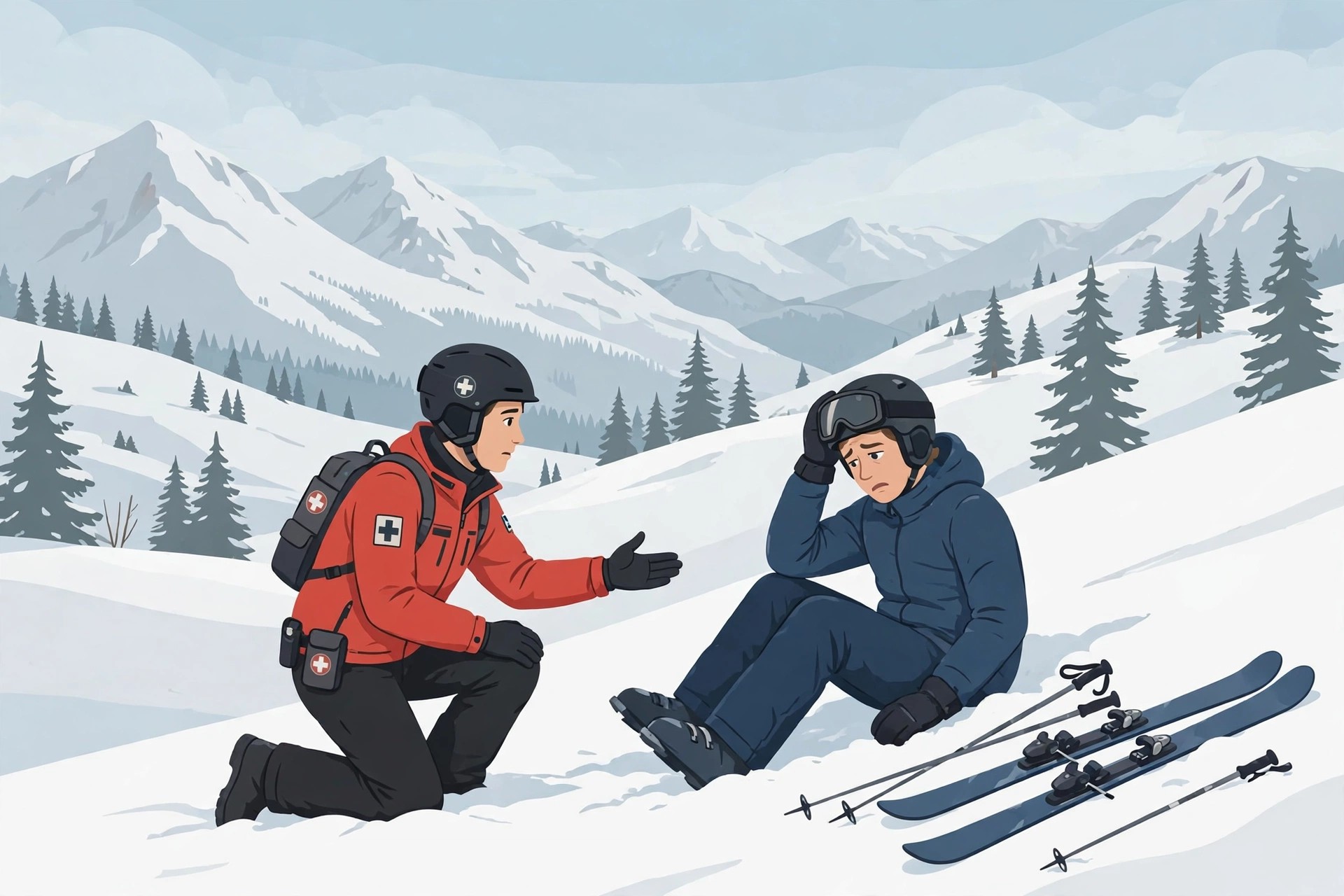
Mark, the answer to "one more run" is no - not even a question. If you hit your head and you do not feel right, your ski day is over. There is no same-day return after a suspected concussion, even if you feel completely better an hour later in the lodge.
A concussion is a brain injury. It can come from a direct hit to the head, like yours, or from a hard fall that snaps the head back and forth, or even a blow to the body that shakes the brain hard enough. You do not have to black out for it to count - most people never do. And your helmet, while absolutely worth wearing, does not change this math. A helmet does a great job protecting against skull fractures and scalp cuts. It does not make you concussion-proof.
Here is the part that trips people up: symptoms do not always show up on the spot. You can feel fine for 10 or 15 minutes and then have the headache, fog, and nausea build over the next few hours. That is why "I feel okay right now" is not a clearance. The signs to respect are a headache or pressure in your head, dizziness or feeling unsteady on your skis, feeling foggy or slowed down or just "not right," nausea, sensitivity to light or noise, blurry vision, trouble concentrating or remembering the run, and feeling unusually irritable, emotional, or sleepy. Any one of those after a head hit means you are done. The same rule applies to kids and teens - if a young skier looks off or complains of any of the above, their day is over too, no debate at the lift.
Why is one more run such a bad bet? After a concussion, your balance and reaction time are measurably slower, even when you would swear you are fine. On skis, that makes a second fall more likely - and a second hit before the brain has recovered can make symptoms worse and stretch a recovery from days into weeks. Missing the last run costs you an afternoon. Pushing through can cost you the season.
So here is what to do instead. Tell a friend or ski patrol what happened - do not keep it to yourself, and do not ski down alone if you feel dizzy, confused, or unsteady. Patrol will get you off the mountain safely. Get checked the same day, especially if symptoms are more than mild. Skip the alcohol that night, do not drive if you feel impaired, and have someone check on you for the first 24 hours. For the first day or two, think relative rest: regular sleep, light daily activity as tolerated, screens and work in moderation. Total isolation in a dark room is outdated advice and is not the goal. You return to skiing only after your symptoms are fully gone, you are back to your usual routine, and a clinician has cleared you to progress in steps.
A few symptoms are not "wait and see" symptoms at all - they mean emergency care, now: a headache that keeps getting worse, repeated vomiting, slurred speech, weakness or clumsiness, confusion that is getting worse, one pupil larger than the other, a seizure, unusual behavior, or growing drowsiness or trouble waking up. If any of those show up, on the mountain or later that night, that is a 911 call, not a good night's sleep.
Elan Goldwaser, DO, is a team physician for U.S. Ski & Snowboard and an Assistant Professor of Orthopedic Surgery at Columbia University in New York City.
Have a ski or sports medicine question? Send it to Ask Dr. G. Reader questions shape what I write next.
For education only - not medical advice.
Next step
Want a personal evaluation?
From the Sidelines is educational. For care, reach the practice directly.