From the Sidelines · Ask Dr. G
Same Neighborhood, Different Injury
Runner's knee is kneecap pain. Jumper's knee is tendon pain just below it. Same neighborhood, different structure - and location is your best clue.
Ask Dr. G
Q: "I am training for a half marathon, and I play volleyball one night a week. Lately my knee aches on my runs, and it hurts again when I jump and land at the net. People keep telling me it could be runner's knee or jumper's knee. Are those actually different problems, or just two names for the same thing?" - Jenna R., Denver, Colo.
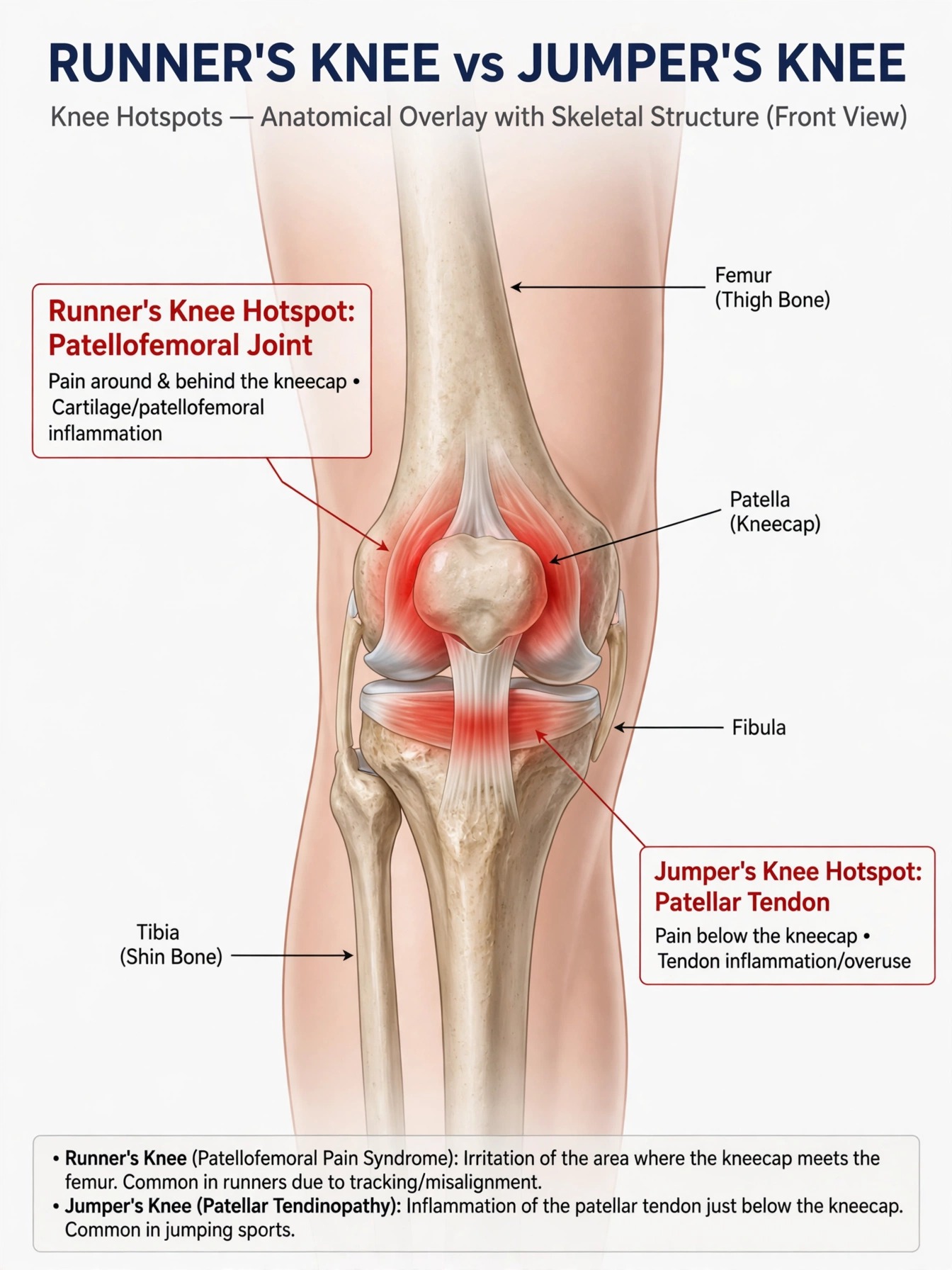
Jenna, they are two different problems - and they happen in almost the same spot, which is exactly why they get mixed up. Runner's knee is pain around or behind the kneecap itself. Jumper's knee is pain in the tendon just below the kneecap. Same neighborhood, different structure, and that difference changes what helps. So before you treat yours, it is worth figuring out which one you actually have.
Start with runner's knee, also called patellofemoral pain. It is irritation where the kneecap glides over the thigh bone. It often aches during running, going down stairs, squatting, or sitting a long time with the knee bent. It can feel worse after a sudden jump in mileage, hills, or training intensity. Underneath it is usually a load and mechanics story: too much, too soon, weak hips and quads, or tight calves and hamstrings. That is why it shows up in runners, hikers, and cyclists who just ramped up their training.
Jumper's knee is a different structure entirely. It is a tendon problem, known as patellar tendinopathy. The pain sits right at the bottom edge of the kneecap, where the tendon attaches, or along the tendon itself. It tends to hurt most with jumping, landing, sprinting, or going down stairs, and it may be tender to the touch in that one specific spot. It builds up from repeated tendon loading, especially in jumping and landing sports like basketball and volleyball. Unlike a single sudden injury, it usually creeps in over weeks, as the tendon gets overloaded faster than it can adapt.
So how do you tell them apart? Location is your best clue. Pain that feels broad, behind or around the kneecap, and worse with prolonged sitting or stairs, points more toward runner's knee. Pain that is pinpoint, just below the kneecap, tender when you press there, and worst with jumping and landing, points more toward jumper's knee. One honest caution: real knees do not always follow the textbook. You can have elements of both, and other problems can mimic either one, so location is a starting clue, not a diagnosis.
The good news is that the first move is the same for both: calm the load down, but do not stop moving altogether. Cut back on the activity that provokes it most, shorten your runs, skip the jumping drills for a stretch, and avoid training through sharp pain. Ice after activity can help with soreness in the short term. Then rebuild strength gradually. Strong quads and hips take pressure off the kneecap, and progressive loading helps a cranky tendon adapt. A physical therapist can set up a program matched to which problem you have, since the right exercises differ - which is why pinning down the location matters before you start.
Some knees should not wait. Get seen promptly if your knee swells a lot, locks or catches, gives way, or you cannot bear weight on it. Also get checked if pain has lasted more than a few weeks despite backing off, keeps coming back, or is getting worse. A clinician can sort out whether it is one of these two problems, something else, or a mix. The bottom line is the one to remember: runner's knee is kneecap pain, jumper's knee is tendon pain just below it. Knowing which spot hurts tells you a lot about what is going on, and both respond best to smart load management and gradual strengthening rather than pushing through.
Elan Goldwaser, DO, is a team physician for U.S. Ski & Snowboard and an Assistant Professor of Orthopedic Surgery at Columbia University in New York City.
Have a knee question you'd like covered in a future post? Send it to Ask Dr. G. Reader questions shape what I write next.
For education only - not medical advice.
Next step
Want a personal evaluation?
From the Sidelines is educational. For care, reach the practice directly.